110 (The Wager)

One of my favorite teachers always gave my friend and I special tasks to do. They often involved leaving the classroom, and we usually received them because we were the first to complete the assignment, project, or task. I remember one random day carrying a TV set out to his car. He even gave us his keys, which in grade 6 was a huge thing. We always knew that when we returned we’d each get a Jolly Rancher. It wasn’t like he had us trained, but we knew the reward was coming.

If he would’ve held back the Jolly Rancher one day, we probably would have been frustrated. While we may not have said anything to him directly, we would have grumbled about it when he was out of earshot. Someone outside this simple little system could watch, observe, and walk in with a wager. “You’ve got great students,” he’d say. “Have you seen Paul?” The teacher would respond. “He does his work quickly, then helps me out after.” “Well, no kidding. You always give him a Jolly Rancher. I don’t know any kid who wouldn’t.”

In that moment, the teacher’s entire system is shot down. It’s the difference between those who follow because of reward, and those who follow because they actually like the teacher.

Satan put God in this dilemma at the beginning of Job. “He only loves you because you bless him,” Satan sneers. To say ‘yes’ admits to a poorly-designed system. To say ‘no’ requires proof. God says “No,” then decides to back it up. And thus follows the book of Job. It’s a challenge to the common belief that obedience equals blessing. Many people believe that today.

At the end, in some of the most beautiful and harsh poetry ever, God puts Job in his place. “Who are you to judge what I do? I can do what I want to do!” He says, sweeping his hand over all of creation. Obedience equals blessing! With one story, God dispatches the notion that following Him means always being blessed. It could end there.

But it doesn’t.

God restores Job, giving him more than he had before. Some would think this ending points to the fact that obedience = blessing, but that’s what God just railed against. No, it’s because God = good.

Taking Heart,

Paul

Do you know what I know?

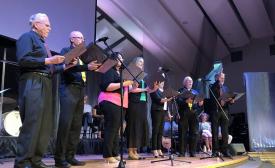
For better or worse I find myself continually interested in knowing, not so much knowledge, or perhaps more specifically I guess I am interested in knowledge about knowing (epistemology to drop the 10 dollar term). Just how is it that we know something to be true, or come to any sort of knowledge for that matter. Listening to a church Christmas concert this year two lines suddenly entered my mind as though encountering them for the first time,

Said the shepherd boy to the mighty king,

Do you know what I know?

The words rushed through me leaving in their wake wave after wave of emotion. Or maybe they dropped on me like stone, like a living stone on my stagnant sense of knowledge and drove the waves outward, out to the ends, to surface of my body that I trust to sense and know the world around me. When waves first peaked they were numbing leaving room for no other thoughts or thinking and as the waves ebbed my returned feelings kept telling me, “But the king has access to knowledge.” What can be known the king is able to know. Now I may not be an explicit fan of the king but if there is something to be known the king can extend the reach of his hand to grasp and acquire it. And what of the rhetorical flaunt that the shepherd boy adds,

In your palace walls mighty king,

Do you know what I know?

No I try not to fly the banner of the king but the truth is that I am on the side of the king. Perhaps I position myself as the king or prostrate myself before kings. This is true because of how these lines offended me deeply, unconsciously. I have been building palace walls in my days even in my sleep.  God forgive me.

There is more than one knowing. There are thrones of knowledge. But there is also knowing that is no knowledge.

And the shepherd boy did not create his own knowing. His knowing was born of seeing and hearing.

Do you see what I see?

Do you hear what I hear?

In this already established new year may we be granted eyes to see and ears to hear a knowledge drifting sometimes rushing low to the ground stealing past palace walls filling the hearts and minds of those without king or country. For the Gospel is a refugee knowledge or maybe a refugee of knowledge tented under the stars and in touch with the wind.

A Collective Work of Art

One of my education assignments involved identifying a metaphor for education and the journey of teacher. Below is my response. Reading it again, I’d like to emphasis even more that the work of art is a collective effort - co-artists with learners and the learning community. I also recognize parallels to other areas of ministry and service. It’s not so much about the skills and tools as the Spirit.

Education requires an artist’s touch. In my journey as a teacher I have come to see learning as a work of art created by the learning community. A successful artist possesses a combination of a love of the art, tools and techniques, extensive experience in mixing colours and painting, and opportunities to share ideas together with other artists. I experience a similar journey as a teacher. While I began with a love of the art of learning, I continue to acquire strategies for teaching, experience in creating learning environments, and sharing through dialogue with other educators.
Palette

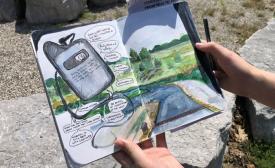
The artist’s palette as a personal symbol reminds me of the art and science of teaching. Artists prepare a variety of colours on their palettes, based on their vision for the work. They know about the science of art, including what results would likely occur when mixing colours, the effect of proportion and line, and the textures of different strokes. They can prepare the appropriate brushes, canvas, and paints. Yet no artist can predict the exact outcome. It takes a certain sense and spirit to respond to the canvas. In the same way, the learning community creates the learning experience together. While the teacher-artist may have skills to decide when to use which instructional strategies, the students, other teachers, and the school environment also shape the learning experience. Despite the best lesson plans, the vision that the teacher-artist had in mind may turn out very differently. The teacher’s role contributes to the learning experience as a work of art, highlights points of beauty, and identifies areas that “work.” As the colours, shapes, and ideas flow into one, the learning experience becomes a beautiful piece of art.

Don’t ya just hate that guy?

I’m not really that articulate in person.  I manage to fool a lot of people because usually when they are listening the most attentively, I’ve had a chance to write things down ahead of time.  I normally only make sense when I’ve first sat down to edit and rearrange my otherwise garbled thoughts.

I was worse as a teenager, more so in the presence of pretty girls. When I wanted to be clever, I sounded weird.  What I wanted to be charming, I was just awkward.  Then, as if I wasn’t doing a good enough job making myself look bad, when we would gather as a group of friends to watch movies, the guys on the screen, who were already significantly better looking than me, delivered lines that made them sound clever, charming and sensitive.

Now, as an adult I find myself still stumbling on similar insecurities.  It should come as no surprise to you that I am interested in theology and spiritual matters, and I hope to somehow earn at least part of my living in this field.  So, to satiate my interest I read books, I listen to radio programs and I attend seminars, etc.  In part also do this to see what the competition is doing.  It can be disheartening to see just how composed, confident and articulate they are, at least compared to me.

As for those romantic movies, the older and more mature I get and the more real life I live, the less credible they become.  Naturally they are intended to be mindless fun and an escape from reality, but numerous studies show that they do in fact impact our perceptions of what can and should happen with regards to love.  If our expectations in this area are affected, even a little bit, it can seriously impact our happiness.  Fortunately, since that time, most of those girls have realized that they didn’t in fact want one of those kinds of guys and have settled for real guys.  Unfortunately, it was right around that time I had actually made some strides towards becoming one of those types of guys.

When I see religious professionals doing well at their jobs, that should push me to become better myself or to get out of the business altogether.  But there are a few reassuring points I’ve learned.  When I listen to a radio interview, it always sounds like the host is coming up with tough questions off the top of her head as the conversation goes on, and the expert guest is immediately giving well thought out answers off the top of his head as well.  What isn’t obvious though is that the host, with careful study and preparation, writes out those questions weeks in advance and gives them to the guest ahead of time so that he has time to compile answers that he is satisfied with.  Then, the two of them act as though their discussion is a smooth and free-flowing conversation, when in fact it is just as scripted as the romance movies I once watched so uncomfortably.  It’s a win-win arrangement for them, since they both come out sounding articulate and intelligent, and the radio program is more interesting as a result.  If they are successful, I will run out to buy the author’s book, and I will continue to listen to the radio program.

Besides my professional insecurities, lots of people (layfolk and clergy alike) struggle in a similar way with their own spiritual convictions.  But in the same way that a boyish Leonardo di Caprio can alter one’s idea of true romance, a phenomenon that I call ‘sound bite spirituality’ can alter how we feel about our own religious self-understanding.  People are drawn to experts and public figures with short, catchy and simple answers to life’s profound spiritual questions.  But these questions are ones that the human race have been struggling with since the beginning of time.  It’s wrong for the church to claim sole ownership of the answers to these questions but an overly simple answer also insults anyone struggling with that question now, and anyone who’s struggled with them in centuries past.  What is it about our age that we are suddenly able to solve these mysteries?  What was wrong with those who went before us, and why couldn’t they see the answer as clearly as we now do thanks to the old man with the British accent on the stereo?

The Christian faith is a journey.  Along that journey it is natural to face both hills and valleys.  The hardships that we face don’t mean that we don’t belong on the journey or that others are journeying better than us.  We are allowed to struggle on our Jesus journey.  Immediately simple sounding solutions to our struggles should not be met with our shame or frustration at not having been able to see the answer sooner, but rather with suspicion at why this person is speaking with such confidence when so many for so long have struggled.

18 (Job Reference)

When you apply for a job, you need a reference. Usually this is someone in a position of authority, and someone who knows you quite well. If they agree to be your reference, it means they’re willing to praise you up and down when they’re called by your potential boss. I’ve had the chance to be a reference for some of the Youth at Douglas Mennonite Church, and it’s a fun experience. You get to tell someone about how much you like someone, expounding on all their awesome traits.

Now picture a different setting: instead of two people conversing over the phone, it’s the Almighty and the Devil standing in the same room. They’re having a conference. And before you even know it, the Almighty brings up your name. For some reason, you get a glimpse into this moment. Me? You whisper, Why’d you have to bring up little ol’ me? Fear runs straight to your toes - you’re worried about the biggest and most valuable reference you’ve ever had.

A character reference from the Almighty.

Recognize the scenario? Maybe you do, maybe you don’t. Here’s what the Almighty had to say about a character whose name, coincidentally, is Job. “Have you considered my servant Job? There is no one on earth like him; he is blameless and upright, a man who fears God and shuns evil.”

If Job had any idea what was going on in the hallowed halls of heaven, I’m sure his jaw would have dropped. Little ol’ me? he might have asked. I mean, I know I try my best…

That’s possibly the best reference I’ve ever heard, and it just so happens to be from the character witness that knows Job like no other.

Put your name here: “Have you considered my servant ______?”

What comes next?

Taking Heart,

Paul Loewen

No Dual Citizenship

pasport1Last week Greg Boyd spoke at Park View Mennonite Church in Harrisonburg, about his book The Myth of a Christian Nation. His main idea was that there is the kingdom of the world, and the kingdom of God and that they are different. You can tell because the kingdom of God on earth looks like Jesus. So if you ever want to know if something world kingdom or God kingdom, just check whether it looks like Jesus or not.

The Anabaptist tradition has centred on this fairly closely, historically. Boyd urged the Mennonites in the audience to keep this voice strong, while at the same time challenging to be flexible and open on everything else that is not about God’s kingdom. A challenge, to say the least.

He emphasized how God’s kingdom is inclusive, radically inclusive, so much that the Matthews (tax collectors) and Simons (zealots who “sometimes assassinated tax collectors”) could follow Jesus together in the same group of disciples, dialoguing, interacting, and focusing on living the God’s kingdom -kind of life.

As followers of Jesus, we can have different opinions and viewpoints on politics and the way the world should go, but ultimately we are gathered together as one in the kingdom of God, which takes priority over all other issues.

So this is my citizenship. I need to remember this and not be confused while living in a ‘foreign’ kingdom of this world. I was reminded that while I can dialogue and challenge and engage the world kingdom, my identity and primary allegiance lies in God’s kingdom. If I choose to follow Jesus, I give up my citizenship to the world. There is no dual citizenship here.

34 litres later

I was walking across the parking lot, its slush-covered surface making the cart bounce.

“I’ll grab that one before you put it back,” a man called out to me.

“Sorry,” I responded, “I’ve got one of the tokens.”

“No problem,” he chuckled, following me to the carts. I pushed it in, then clicked the holder out, the token falling to the ground in the process. “Is it a good cart?”

“Didn’t give me any troubles; I didn’t run into anything,” I laughed. He laughed out loud, and we said goodbye in the same tone of voice you speak in when you say goodbye to a lifelong friend.

Three minutes later, I had pulled in to fill up our car at Co-op.

“What do you need today?” the guy asked me.

“Fill regular,” I responded, and he proceeded to fill it up. He then made casual conversation about the car, my iPod, and a few other items. By the time I drove away (how long does it take to pump 34 litres?) we, too, sounded like best friends.

Maybe you’ve had experiences like this. Maybe you haven’t. Either way, it reminds me that we’re not isolated. We’re not little islands in a big ocean. We’re traveling down this journey called life with many people near us. They may be heading in a different direction, but our roads can cross for a second. More than anything, I learned today how a simple conversation can bring a smile to my face, can make the day a little brighter.

Taking Heart,

Paul Loewen

Truth and Lies…

InventionI watched “The Invention of Lying” the other night. Despite the trite descriptions of “the man in the sky” and the obvious Moses-mocking with pizza boxes in either hand, the movie prompted some interesting thoughts on the narratives humans tell ourselves and the role that those narratives play.

The main character, Mark, lives in an alternate reality where people can only speak the truth in full, complete with embarrassing an d hurtful details. One day, he discovers that he can speak something that “is not” while at the bank. He starts out by using this new ability for his benefit, but soon realizes that sometimes speaking what is not can bring hope, happiness, and encouragement to others, including telling his suicidal neighbour that “everything is going to be alright.”

In his book “Helping,” Edgar H. Schein describes the cultural norms and social language Helpingwe follow in helping one another, including stories, roles, and narratives as depicted in the film. In fact, he uses the term “theatre” as a metaphor for the patterns of human interaction that we depend upon to keep functioning socially. Mark’s use of these narratives even in his world that usually doesn’t follow them pushes him up in social status and admiration of others. Awareness of these narratives and their emotional impact can empower us to help and be helped and to avoid causing hurt through our helping attempts.

I’m reminded of the passage in Ephesians describing unity in the body of Christ, and the growth of followers of Christ, “speaking the truth in love” along the way. This requires an investigation of the narratives we use and to what extent they constitute “truth” while at the same time “in love.” Words of encouragement, affirmation, and hope do not necessarily stem from what “is not” but from the truth framed in Christ-like love for others.

By the end of the film, Mark realizes that lying holds no appeal when with someone he loves. Instead, he learns to look for the affirming truths in others and to speak those in place of truths that hurt. Not bad for a simple comedy.

Re-Think

Jesus, the Son of God, to God, the Father in Heaven.

I always am grateful for you, because you have sustained me and carried me through so many trials and temptations, through pain and difficulties. You have given me power and perseverance when it was necessary, and delivered me from the grasp of death.

Because of this, it would be within my power to tell you what you should do, but instead I’m appealing to you on the basis of love. I, as Jesus – your slain and resurrected Son – appeal to you for my sons and daughters, who have put their faith in me and in my power. Formerly they were sinners, now they have been redeemed by grace. I am sending them to come before you, so that you, too, can experience the joy I have experienced. I am not forcing you, or commanding you, but giving them to you with a smile on my face. While they used to be separated from you, it was only for a time so that they could come to you in fullness – not as a sinner but as a redeemed child. I love them with all my heart. So, as your Son and partner, welcome them as you have always welcomed me.

As they have disobeyed and done things wrong, I will step in and pay the penalty for them. Knowing that you will welcome them and go further by lavishing your love, joy, and blessings on them, I thank you.

This letter is based on the format and outline of Philemon. When I wrote it, it blew my mind to think about Jesus’ relationship to us in this way. It made me seriously re-think things. I hope it does for you as well.

Taking Heart,

Paul Loewen

Space Discoveries

As the new year begins, I find myself reflecting on the year that has passed and planning for the year to come. Like many people, I’m sure. Setting goals and resolutions, renewing commitments and promising to change usually come to mind.

Recently, though, I’ve been thinking about my need for space. Prompted by a study of Barry Hart’s “Peacebuilding Wheel” in relationship to peace education in a class last year, the concept of physical, emotional, and relational space continues to come to my attention.

I know that I need physical space. I realized the extent of my claustrophobia in Korea on the packed 11pm underground trains where my breathing was interrupted by the push of people against me. What does it mean, though, to have emotional and relational space? How does that relate to time?

In the last year, I experienced the loss of a good friend. Through the grief process, I’m starting to understand the need for emotional space. While I rarely give myself the freedom to just feel what I feel, I see the negative impacts this lack of space has on me and the people close to me. When I do give myself space to grief, to listen to my feelings and how my body is telling me it needs me to listen, I come to a sense of release and renewal. If I have emotional space, the grieving process can continue in healthy and life-giving ways.

The relational concept of space creates a place for friendships and connections to be nurtured. When I have my to-do list and I am so busy checking off on thing and the next, being productive, I more than likely will miss the nuances of my spouse’s facial expressions and forget to ask how his day has gone. I tend to rush out of the student lounge after saying hi to a few from my class to get back to my office and “get things done” rather than sit together with honesty and presence. Relational space draws me into the lives of others, and makes their stories my own. It creates the opportunity for authentic encounters.

So perhaps this year my resolution is not doing something new, but letting go and creating space. I seek to focus less on doing and more on being. In some ways, it’s easier to resolve to add more commitments and promises to my schedule than to honestly reflect in space which may frighten and threaten me with its emptiness. I find it more difficult to stop, release, and be present. I sense, though, that Hart’s “Peacebuilding Wheel” has something that I’m missing as one who seeks to create peace. This year, I’d like to discover some space.